BLOG POST
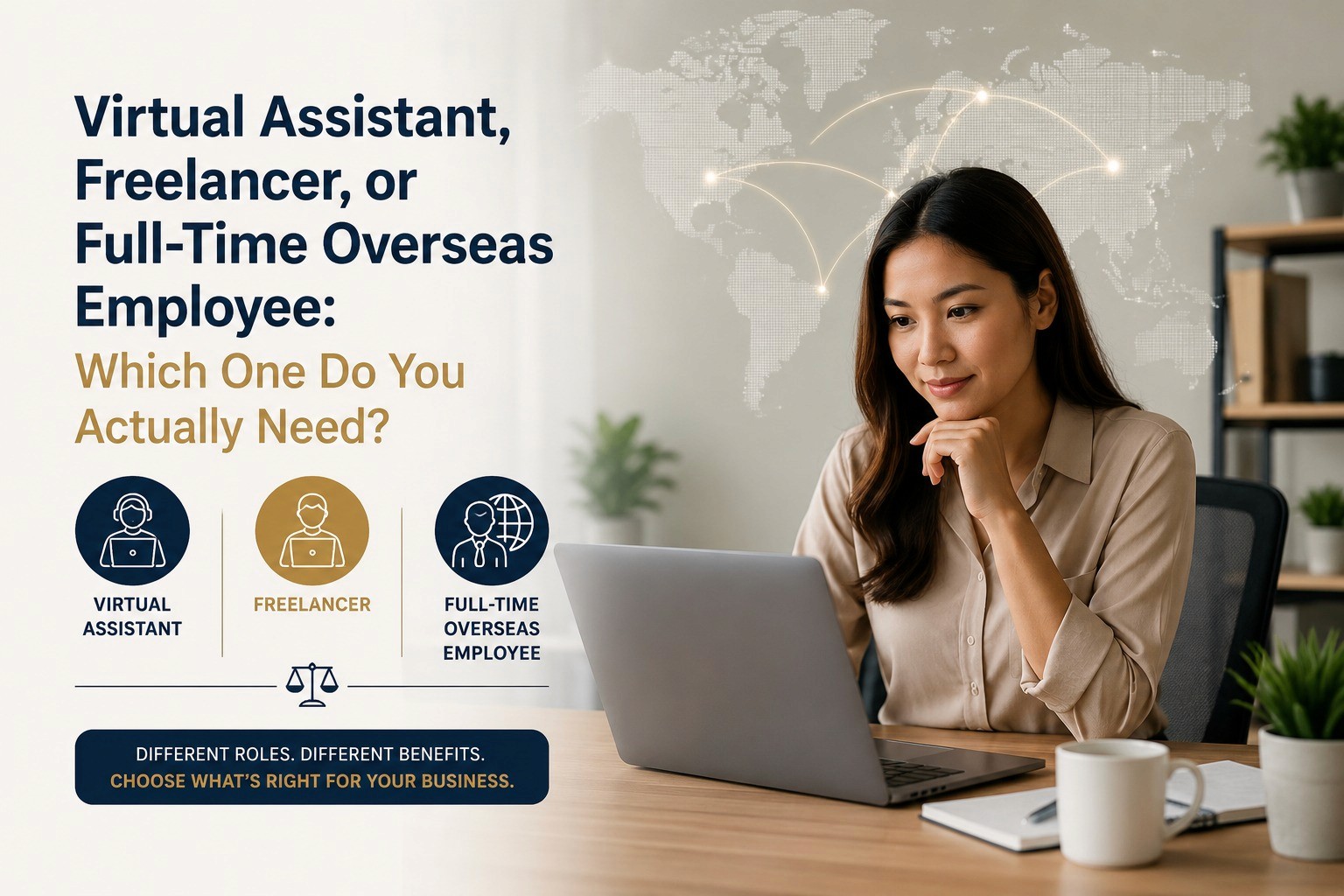
Virtual Assistant, Freelancer, or Full-Time Overseas Employee: Which One Do You Actually Need?
•
Sagan Passport
•
13 min read
SECTION 1
Quick Comparison: Virtual Assistant vs Freelancer vs Full-Time Overseas Employee
SECTION 2
Why Most Small Businesses Choose the Wrong Type of Help
If you have ever sat at your desk knowing you need help but unsure what kind, you are not alone. Most small business owners reach this point and immediately start Googling "virtual assistant" or "freelancer," and within an hour they are more confused than when they started.
The categories blur together. The pricing pages all sound the same. The advice online is mostly written by people trying to sell you something.
At Sagan, we help small businesses hire full-time overseas employees, so we talk to founders about this exact decision every week. The pattern is almost always the same. Owners try to choose based on cost, and they end up with the wrong kind of help for the job they actually have.
This article is not about which option is best. None of them is best. They solve different problems. The real question, and the one most owners do not ask, is how much ownership your business needs from the person you hire.
SECTION 3
Why Business Owners Get Confused About These Options
Virtual assistant, freelancer, contractor, offshore employee, remote staff, overseas hire. These terms get used as if they mean the same thing. They do not.
Some refer to the type of work (project versus ongoing). Some refer to where the person lives (overseas versus local). Some refer to the contractual relationship (employee versus contractor). And some are just marketing words that platforms invented to sell their services.
The confusion is not your fault. The industry has done a poor job of drawing clean lines between options that look similar on the surface but behave very differently inside a real business.
Here is the cleaner way to think about it. Forget cost for a moment, and ask how much ownership you want the person to take.
SECTION 4
What Is a Virtual Assistant?
A virtual assistant, usually called a VA, is someone who handles administrative and operational tasks remotely. They are typically paid by the hour or on a small monthly retainer.
Typical responsibilities
Inbox and calendar management
Booking travel and meetings
Light research and data entry
Customer service replies
Invoice and receipt tracking
Basic social media posting
Pricing - Most VAs charge between $8 and $35 per hour depending on where they are based and what they specialize in. Some virtual assistant services sell hours in blocks of 10, 20, or 40 per month.
Strengths - VAs are fast to onboard. They are good at clearing the small stuff off your plate. They let you stay focused on higher-value work without committing to a full-time hire.
Limitations - A VA works at the task level. They do what you ask, often well, but they generally do not own outcomes. If the inbox gets messy, that is your problem to notice. If a customer issue starts to spiral, they will wait for your direction. Many VAs also work for multiple clients at once, which means their attention is split.
Who they fit - A solo consultant who needs their calendar protected. A residential cleaner who needs help replying to inquiries. A real estate agent who wants someone to handle MLS listings and client follow-ups. Anyone whose main need is "get this off my plate" rather than "make this function run."
SECTION 5
What Is a Freelancer?
A freelancer is a specialist you hire for a defined piece of work. They have deep expertise in one area, and they sell that expertise by the project, the hour, or sometimes through a monthly retainer for a specific scope.
Common examples
Designers, copywriters, web developers, video editors, paid ads specialists, SEO consultants, branding strategists, bookkeepers, and fractional CFOs all commonly work as freelancers.
Pricing
Freelancers usually cost more per hour than VAs because you are paying for specific expertise. Rates range widely, anywhere from $40 to $300 or more per hour, with project rates varying based on scope.
Strengths
You get someone who knows their craft. They can deliver work you would not be able to produce yourself, and they do not require training in their area of expertise.
Limitations
Freelancers are not always available when you need them. The good ones are usually busy. They are also focused on their project, not your business as a whole, which is appropriate, but means they will not catch problems outside their lane.
When the project ends, the relationship ends. If you need ongoing work, you have to either keep finding new freelancers or convince the same one to keep working with you indefinitely. Most do not want to.
Who they fit
A small business that needs a logo, a new website, a marketing campaign, a tax filing, or a video edited. Discrete projects with clear deliverables. Not the right fit when the work is continuous, evolving, or needs daily attention
SECTION 6
What Is a Full-Time Overseas Employee?
This is the option most small business owners do not seriously consider, often because they assume it is only for big companies. It is not.
A full-time overseas employee is exactly what it sounds like. Someone who works for your business full time, takes ownership of a role or function, and treats your company as their primary professional commitment. They just happen to live in another country.
This is what Sagan was built for. We help small businesses in the US, UK, and Canada hire full-time overseas talent across roles like operations, marketing, finance, customer success, and executive support. International hiring has become one of the most reliable ways for small businesses to access experienced talent at a sustainable cost.
The shift from a VA or freelancer to a full-time overseas employee is not just a pricing change. It is a fundamentally different relationship.
What changes when someone owns a role
They learn your business, not just their tasks
They notice problems before you do
They participate in team meetings
They build relationships with your customers and vendors
They develop opinions about how to make things better
They stay long enough to compound institutional knowledge
This is what people mean when they talk about overseas staffing solutions as more than a cost play. The savings are real, but the bigger advantage is that you get someone whose job is to make your business better, not just to complete tickets.
What changes when someone owns a role
They learn your business, not just their tasks
They notice problems before you do
They participate in team meetings
They build relationships with your customers and vendors
They develop opinions about how to make things better
They stay long enough to compound institutional knowledge
This is what people mean when they talk about overseas staffing solutions as more than a cost play. The savings are real, but the bigger advantage is that you get someone whose job is to make your business better, not just to complete tickets.
How this differs from a VA or freelancer
A VA handles tasks you assign. A freelancer delivers a project then leaves. A full-time overseas employee owns a function the way a domestic full-time employee would, often for less than half the cost, and stays year after year.
It is also a bigger commitment. You are responsible for managing them, integrating them, and giving them work that justifies a full-time role. That is the trade-off.
Side-by-Side Comparison
Here is how the three options stack up on the dimensions that actually matter:
Dimension | Virtual Assistant | Freelancer | Full-Time Overseas Employee |
Cost | Lowest per hour | Highest per hour | Mid-range, full-time salary |
Availability | Part-time, shared | Limited, project-based | Full-time, dedicated |
Training investment | Minimal | None for their skill | Significant upfront |
Accountability | Task-level | Project-level | Role and outcome level |
Scalability | Add more hours | Hire more freelancers | Build a team over time |
Specialized expertise | Generalist | Deep specialist | Specialist or generalist |
Long-term value | Short to medium | Project-bound | Compounds yearly |
Management required | Low to medium | Low | Medium to high |
As you move from VA to freelancer to full-time overseas employee, you trade flexibility for ownership. There is no right answer in the abstract. There is only the right answer for the work you need done.
SECTION 7
Which Option Makes Sense for Different Types of Businesses?
A home service company (plumbers, electricians, HVAC, landscaping) usually needs steady support for scheduling, dispatch, customer follow-up, and AR collections. That is ongoing work, not a project. A full-time overseas employee in operations or admin almost always beats a VA here, because someone who knows the customer base and the technicians will outperform someone who is just answering tickets.
An accounting firm has predictable, repetitive work that grows with clients. Bookkeepers, tax preparers, and audit support staff are excellent full-time overseas roles. The savings across a small team can be substantial, and the work benefits from continuity, since the same person can handle the same client year after year.
A marketing agency usually needs a mix. Freelancers make sense for one-off creative projects like a brand identity or a launch video. The recurring work, ad management, reporting, social posting, account coordination, is better served by overseas employees who know each client's account history.
A real estate business often starts with a VA for transaction coordination and listings. As the business grows, a full-time overseas employee who owns the transaction process end to end becomes a much better fit. The VA covers the activity. The employee owns the result.
An e-commerce company has continuous demand for customer service, listing management, supplier coordination, and ad optimization. These are not project jobs. They are operational functions. Hiring remote workers abroad on a full-time basis fits this model well, and many e-commerce founders end up building entire offshore teams over time.
A professional services firm (law, consulting, financial advisory) typically uses freelancers for specialized work like compliance audits or branded marketing, and full-time overseas employees for ongoing client coordination, paralegal support, research, and operations.
SECTION 8
The Most Common Hiring Mistakes
The same patterns come up over and over.
Hiring a VA when you actually need a specialist. Owners often want a "VA who can also do marketing." That person rarely exists at VA rates. You will get someone who is okay at neither.
Hiring a freelancer when you need ongoing support. Founders try to keep a freelancer on retainer for work that is really a full-time role. The freelancer eventually leaves, raises their rates, or de-prioritizes you for a bigger client.
Hiring a full-time employee before your processes are defined. If you do not know what the role looks like day to day, you are about to pay someone full time to figure it out for you. That can work, but it is slow and expensive.
Choosing based only on cost. Cheap help that does not own anything is more expensive than it looks once you factor in your time managing it.
Expecting immediate results without any training. Even the best overseas hire needs to learn your business. Owners who skip the onboarding and then blame the hire usually end up cycling through people.
SECTION 9
Questions to Ask Before You Hire Anyone
Before you post a job or call an agency, think about these basics:
Is this work a one-time project or an ongoing function?
Do I need someone to do tasks, or to own outcomes?
Do I have processes documented, or will the person need to build them?
How many hours a week of work is actually here?
If this person did everything I hoped, what would they own a year from now?
Am I ready to manage someone, or do I want a self-directed expert?
What is the cost of this work not getting done well?
If the work is ongoing, the answer is rarely a VA or a freelancer. If it is a one-off project, it is rarely a full-time hire. The honest answers usually point you in the right direction.
SECTION 10
The Real Question Is Not Cost
Most owners frame this decision as a budget problem. "What can I afford?" That is the wrong starting point.
The better question is, "What does my business actually need someone to own?"
If the answer is "nothing, I just need help getting tasks done," a VA is fine. If the answer is "a specific deliverable I cannot produce myself," a freelancer is right. If the answer is "an entire function, run consistently for years," you need a full-time employee, and overseas hiring is one of the most effective ways for a small business to afford that.
Ownership is what separates a hire that compounds value from a hire that just handles your overflow. Cost matters, but it is downstream of getting the model right.
SECTION 11
Bringing It Together
There is no winner among VAs, freelancers, and full-time overseas employees. There is only what fits the work in front of you.
If your need is tactical and short, a VA or freelancer is probably enough. If your need is a function that should keep getting better year after year, a full-time overseas employee is almost always the better answer, both for the work and for the economics.
This is the model Sagan helps small business owners build. We focus specifically on full-time overseas hiring because it is the option most often overlooked and most often the right fit for a growing business that has outgrown task-level help. We handle the sourcing, vetting, and placing of experienced overseas talent for roles where ownership matters.
Whatever you decide, do not let the labels confuse you. Match the model to the work, hire for ownership rather than tasks, and you will avoid the most expensive mistake small business owners make when they try to bring on help.
More from the blog
BLOG POST
What It Actually Costs to Hire an International Remote Employee (and When It Makes Sense)
10 min read
BLOG POST
What Is Offshore Staffing? A Guide for Small Business Owners
18 min read

Ready to build
your offshore team?
Hire better.
Not just cheaper.
Get matched with top overseas talent and a dedicated support team.
Schedule a Call →
◇ Pre-vetted, top 1% talent
◇ Full-time, dedicated team members
◇ Payroll, compliance & HR support
◇ Start in as little as 2–3 weeks